

What is barrier paper and what can it do?
"MORE" paper and "LESS" plastic is our solution!

FAQs
What are barrier papers and why are they a packaging material of the future?
Barrier papers are special papers with functional surface coatings. At delfort, they consist of at least 80% FSC-certified cellulose fibers and are therefore easily recyclable in the existing waste paper cycle. These base papers contain a special mix of fibers and fillers for optimal runnability on high-speed processing and packaging machines. The papers are usually highly calendered and prepared for surface coatings. These ultra-thin surface layers (layer thickness of a few micrometers) guarantee the necessary barriers (e.g. against grease, water vapor, oxygen, aroma, mineral oils, etc.) and heat sealability for use in flexible packaging for food and non-food items. As barrier papers can still be recycled in the normal waste paper cycle due to the low proportion of coatings and also have a good ecological footprint, they are a sustainable alternative to plastic and composite packaging for many applications.
What are the barriers in barrier papers made of? Are barrier papers plastic-free?
The ultra-thin barriers in our thinbarrier® products generally consist of thin polymer films formed from aqueous dispersions. These are finely dispersed, functional polymer particles in water. Such coatings, usually still fossil-based, are also known from the paint and adhesives industry. After coating the paper, the water is dried - as in paper production itself - and the polymers form a closed film. The formulation, additives and coordination of the dispersion formulations with each other guarantee an effective barrier against grease, water vapor, oxygen or aromas and are our secret. We are already using the first barrier coatings made from renewable and biodegradable plastics to further improve the ecological footprint of our barrier papers. We are currently developing completely plastic-free barrier papers (i.e. with main structural components made from non-chemically modified biopolymers), but these do not yet achieve the necessary high barriers for food packaging.
What specific barrier values can be achieved with barrier securities?
In order to transport and store food safely over a longer shelf life, chemical-physical barriers are required that would not be achievable with conventional papers and without functional surface coatings. On one hand, a barrier against fats and oils is necessary, which we achieve both by mass treatment of the paper and by coating systems on the paper surface that are as defect-free as possible. We measure the highest KIT value of 12 for thinbarrier® products and the best level 5 in the palm kernel grease test, even in folds and over several weeks. An equally important barrier, especially for dry foods, is the water vapor barrier (MVTR), which we measure in dry conditions (23 °C/50 % humidity), standard conditions (23 °C/85 % humidity) and in tropical conditions (38 °C/90 % humidity). Here, plastic films perform particularly well with MVTR barriers under standard conditions of less than 1 g/m² day. Our best barrier papers currently achieve values below 10 g/m²-day here, so we are approaching the values of plastic. Metallized plastic films, however, achieve values of less than 0.1 g/m²-day. In terms of barrier against oxygen, barrier papers are already better than standard plastic films such as PP, PE and PET. We measure values of less than 5 cm³/m²-day at 23 °C/50 % humidity. With plastic, these values are only possible with additional barrier layers (e.g. EVOH). There are other barriers that can be relevant in food packaging (e.g. aroma, MOSH/MOAH, UV etc.). Barrier papers are also comparable with conventional plastic films for these requirements.
How easy/difficult is it to switch from plastic film to barrier paper in an industrial environment?
A change of packaging material is a fundamental strategic decision with far-reaching consequences for branded goods manufacturers. It must therefore be well thought out and secured in all aspects. At DELSCI, we are specialists in this transformation process and support our customers in material selection, process optimization and approval along the entire value chain. From this perspective, the switch from plastic to barrier paper is quite complex, but pays off in the medium term due to the far more favorable eco-taxes in most countries and the sustainable image among end consumers. According to Pro Carton's European Consumer Packaging Perception Study 2025, 89% of consumers in Europe prefer paper packaging to plastic when given the choice(https://www.procarton.com/wp-content/uploads/2025/03/Storm_Pro-Carton_Consumer-Survey_Report-2025_final.pdf).
Both in the printing process and in the packaging process, our high-performance papers have excellent running properties, comparable to plastic films. We also put our papers through their paces internally in all of our customers' manufacturing processes (printing, filling and packaging, storage, transportation) and provide support for challenging process steps.
Are barrier papers compatible with the Single-Use Plastics Directive (SUPD)?
The short answer to this question is: "It depends." Packaging falls under the SUPD if it is (1) made entirely or partially of plastic (a threshold is not defined) and (2) is not reusable and (3) - in the case of food packaging - is intended for direct consumption. (For example, most frozen food packaging does not fall under the SUPD.) Caution: ice cream on a stick does
According to the SUPD, plastics are defined as polymer-based materials (see definition in REACH) that serve as the main structural component of packaging. This excludes biopolymers that have not been chemically modified and non-continuous layers of coatings, paints and adhesives.
Most of our barrier papers therefore only fall under the SUPD if they are used as packaging for products for direct consumption. However, we are already working on barriers with chemically unmodified biopolymers.
It must be noted that the interpretation of the SUPD is subject to national interpretations and that there are therefore gray areas for barrier papers (e.g. interpretation as a main structural component). A ban on barrier papers under SUPD is also very unlikely in the future, but manufacturers could, for example, be subject to labeling obligations.
Are barrier papers compatible with the Packaging and Packaging Waste Regulation (PPWR)?
The PPWR applies to all packaging in the EU, regardless of the material, while the SUPD only applies to a specific part of packaging, namely single-use plastics.
First of all, it must be emphasized that the PPWR does not replace the SUPD, but adds to it. The SUPD remains a more specific rule ("lex specialis") and takes precedence within its scope of application (single-use plastics). The PPWR has been in force since February 2025 and will be binding from August 2026. The PPWR is a regulation (the SUPD is a directive), which is therefore directly applicable in all EU member states (without additional national laws or regulations).
The PPWR clearly focuses on recyclability on an industrial scale, on consistent design-for-recycling and on conformity and documentation requirements. The criteria for the recyclability of a barrier paper are currently being developed within the framework of so-called design-for-recycling tables. These tables form the binding basis for the assessment. In addition, the CEPI recycling test protocol can be used to prove recyclability.
We will soon also be offering coatings with a recycled content for our product - without compromising the barrier performance.
Finally, it should be mentioned that the future disposal costs (EPR) of packaging are determined directly by the recyclability according to PPWR. For our customers, this means that the total costs for packaging with good industrial recyclability, such as our barrier papers, will fall, while those for packaging with poor recyclability will rise dramatically.
How expensive are barrier papers compared to plastic and composite films?
In addition to their good MVTR barriers, standard polyolefin films such as PE and PP are used by many packaging customers primarily due to their low cost. These plastic films generally have a very good water vapor barrier, but have weaknesses in the grease and oxygen barrier as well as in processing (e.g. heat sealing, printing). For this reason, these films are usually combined as duplex and triplex systems (e.g. OPP/PE) or provided with high barriers (e.g. EVOH, metallization). This generally leads to poor recyclability and higher material costs, and in future also to significantly higher disposal costs.
The minimum recycling obligation for plastic films from 2030 will drive up the material prices of such packaging further, as the availability of food-grade recyclates poses a major challenge for the industry.
Depending on the design of the barrier, barrier papers currently cost significantly more than simple polyolefin films, but less than composite films. However, material prices will converge in future due to the mandatory design-for-recycling requirements for barrier papers and monofilms. The use of laminated films is likely to decline sharply over the next few years and only remain in niche applications.

Microplastics, deforestation, loss of biodiversity? What is the situation?
The ultra-thin polymer dispersion layers on barrier papers are completely separated as rejects in waste paper recycling and are usually thermally recycled or used as a filler in building materials. This means that no relevant microplastics enter the paper cycle. Even if barrier paper ends up in nature due to careless disposal, the main part of the packaging (the paper) decomposes into CO₂, biomass and fine, inorganic components within a few weeks. From the remaining, very small, fossil and non-degradable plastic content, small amounts of microplastics can form over years at some grades. However, this minimal residual input bears no measurable relation to the microplastic input from plastics, for example through abrasion from synthetic textiles and car tires.
Our barrier papers come exclusively from certified sustainable forestry (FSC®, PEFC) and not from deforested wood. Several reputable sources (Eurostat, FAO, UN-ECE, EFI) confirm that European forests are growing in both size and quality through sustainable forestry. Paper from certified forests can therefore promote biodiversity, provided that forestry is practiced in a near-natural way.
For which applications does the use of barrier papers make sense today?
The challenge with barrier paper lies in the optimal compromise between barrier performance and the ecological footprint of the packaging. It is easy to understand that hydrophobic, non-fragmentable barriers work against paper recycling - where paper is defibered again in a "cooking pot" with water. Metallization layers can also have a negative impact on the quality of the recycled fibres.
We see this ideal compromise at barrier values for water vapor (MVTR 23 °C/85 % humidity) and oxygen (OTR 23 °C/50 % humidity) of approx. 1 -10 g/m² day.
Today, we achieve grease barriers without PFAS chemicals (formerly used hydrophobic and lipophobic substances, now banned) and exclusively with natural, lipophobic components or physical coating effects.
As a result, the process and application window for barrier papers today lies in the areas of confectionery and chocolate bars, frozen and deep-frozen goods, dry foods, butter and soft cheese, as well as a wide range of applications in the non-food sector.
Recyclability vs. compostability - which makes more sense when?
We are committed to good recyclability of barrier papers. As we use high-quality fresh fibers in our papers, we know that such fibers can be reused up to 20 times if collected, sorted and recycled correctly. This makes ecological sense (production of recycled paper) and is economically advantageous (high market value of recycled fibers).
What's more, we have a very efficient recycling infrastructure for waste paper in Europe with recycling rates of over 80%, which means we already meet the strict requirements of the PPWR for 2030 and beyond.
Compostability can be a useful addition in certain applications (e.g. heavy contamination from food waste) and in certain markets (so-called "leakage markets" without recycling infrastructure).

What is the CO2 footprint of barrier paper compared to plastic films?
We have carried out product carbon footprint calculations for all our barrier papers (in accordance with ISO 14067 / cradle-to-gate, from raw material to delivery of the paper) on the basis of primary data from the manufacturers (Scope 3), secondary data from renowned LCA databases and our own calculations (Scope 1 and 2). The results are significantly lower than those of conventional plastic films (detailed data is available on request).
These good results are primarily due to the low weight (low thickness) of our barrier papers, the sourcing of primary fibers as regionally as possible, the use of ultra-thin dispersion coatings and our energy-efficient production with a very high proportion of alternative energies in delfort's paper mills.
We have also started the first cradle-to-cradle calculations (full life cycle including recycling credit) for barrier papers. Even without taking into account biogenic CO₂ sequestration (i.e. the CO₂ bound in the paper through biological processes), we obtain even more advantageous results compared to plastic, so it can be summarized that the CO₂ footprint of barrier paper is significantly more favorable than that of plastic films, but depends on where the system boundaries are drawn in the calculation.

How DELSCI supports your sustainable packaging transformation
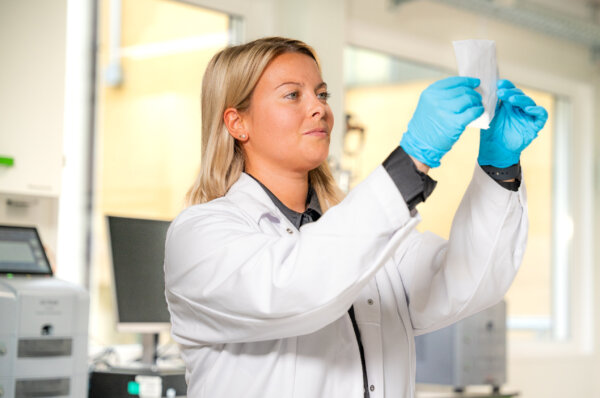
Our 20-members team consists of scientists, engineers and technicians. We have been working intensively on the development of barrier papers for a wide range of packaging applications since 2020. We have collected and analyzed a large amount of chemical and physical data on our products as well as process data from the processing of barrier papers (printing, packaging, transport, shelf life) in databases.
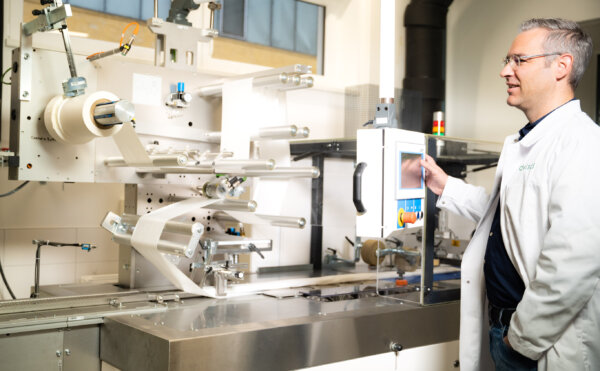
We have mapped large parts of the downstream process chain of our products in our laboratories and operate a recycling laboratory (tests according to CEPI, PTS, Aticelca), a packaging laboratory (with an HFFS machine) and a shelf-life laboratory. In the delfort Printing Group, the delfort Group has bundled concentrated knowledge of printing inks and printing technologies, which we at DELSCI can access directly.
Our application engineers have accompanied a large number of proofing and packaging trials, optimized the processes together with our customers and gained valuable experience in the process. We therefore know the most important relationships between our materials and our customers' products and processes. We use this knowledge and experience to support our customers in the challenging transformation of their packaging.
How do DELSCI and delfort AG work together?
DELSCI is set up as an independent research company, but works exclusively with delfortgroup AG on the development of barrier papers.
Together, DELSCI and delfort have established a cross-company product development and innovation process based on a stage-gate model. DELSCI is responsible for development and prototyping, while delfort is responsible for production, sales and marketing.
Our customers are supported in challenging projects by a joint team of DELSCI and delfort experts. This organization works in an agile manner and relies on open innovation with external partners as well as design thinking methods with the users of our barrier papers.
How do we work at DELSCI?
Who works at DELSCI?
Let's work together!
Are you ready for the next step? Get in touch with us! Just send us an e-mail and we'll get back to you.